mancho oniashvili, Author at My WordPress Website

Within the framework of the construction of the Kvesheti-Kobi road and tunnel, a campaign to raise awareness of road safety was held at the Kvesheti public school. The Kvesheti-Kobi road project is being implemented under a loan agreement with the Asian Development Bank (ADB) and the European Bank for Reconstruction and Development (EBRD), where the 9 km long and 15 m in diameter tunnel excavation has already been completed, as well as the construction of a 9 km long evacuation tunnel, the construction of the access road and the remaining artificial structures is actively ongoing.

The road safety awareness raising campaign held at the Kvesheti and Gudauri public schools covered two target groups, namely students from grades I-V and VI-XII.

Within the framework of the campaign, representatives of the Roads Department provided students with information on the road safety requirements that must be observed by pedestrians, such as crossing at zebra crossings, riding bicycles, moving during nighttime hours, and others.

It is also important that the Department carries out awareness-raising campaigns not only for this particular project, but similar activities are envisaged within the framework of the construction of several other main roads. Only this year, a road safety awareness campaign was held for about 3,400 beneficiaries, including 800 school students, in the municipalities of Kharagauli and Zestafoni.

The road safety awareness raising campaign aims to raise the awareness of various groups of the public and their involvement in improving road safety. Such social projects are very important in the activities of the Department and will continue in the future.

Farmer assistance and agricultural research

On September 17, 2024, with the help of trainers employed by the United Nations Food and Agriculture Organization (hereinafter – “FAO”), in the villages of Dusheti Municipality (Kvesheti, Arakhveti, Bedoni, Jagmiani and Benyan-Begoni) farmers (total 49) who are engaged in cattle breeding were given cheese making powder, mineral additives for cattle feed and equipment for calves.


On the same day, FAO agronomist visited two land plots, where potatoes were planted. They took the first test crop. In each plot, 6 types of potatoes were planted in order to demonstrate the ability and efficiency of adaptation to the site.


On September 18-19, FAO representatives conducted a survey of farmers in four locations – Jaghmiani, Benyan-Begoni, Bedoni and Kvesheti. The purpose of the survey was to reveal the knowledge obtained as a result of the trainings, to assess the satisfaction of the activities carried out, to identify areas for improvement in the future.

Training in Grilled Cheese Production


On August 7, 2024, with the help of trainers employed by the United Nations Food and Agriculture Organization (hereinafter – “FAO”), a group of farmers in the village of Jaghmian, Dusheti municipality, conducted a training on the production of grilled cheese. The training included both theoretical and practical courses. With the help of a specialist, the participants of the training took out the cheese with the help of a new technology, which was finished by tasting it. The advantage of producing this type of cheese is that it can be prepared quickly and safely (it is processed at a high temperature), and it has a much higher price than traditional cheese. The training was attended by 7 participants (women) from the villages: Jaghmian, Seturebi and Sharmiani.

Trainings in potato growing and cheese production

On July 5, 2024 the Food and Agriculture Organization of the United Nations (Hereinafter – “FAO”), organized the training session on Potato Production for a farmer group in the village Benian-Begoni, with six farmers (5 females and 1 male). The training was conducted at one of the farmer’s house, in the village. The topics covered soil preparation, selection and preparation of seed material, sowing, plant nutrition, and identification and prevention of diseases.


On the same day, the FAO conducted a training session on Grilled Cheese. Technology for the same group of farmers in the village Benian-Begoni. The training comprised both theoretical and practical parts, including the preparation and testing of grilled cheese by the participants. The training participants have been provided with the equipment for cheese production.
Participants expressed gratitude for the training program, noting that it enhanced their knowledge in potato production, cattle farming, and cheese production.


6 types of potatoes were planted in the village Tskere and Seturebi with the help of “FAO” trainers

On June 5, 2024, the Food and Agriculture Organization of the United Nations, established two demonstration plots – one in the village Seturebi and another in the village Tskere. On 400 square meter of each land plot, six types of potato seeds were planted.


FAO aimed to identify which types of seeds are most effective in the region, and to demonstrate the significance of selecting the proper type of seed and importance of proper care during growth. FAO will provide consultations during regular site visits and supply fertilizer throughout the entire cycle.

Trainings in the field of agriculture

On April 24, 2024, the Food and Agriculture Organization of the United Nations conducted training on potato production in the village of Jaghmiani, Dusheti Municipality. 6 farmers attended the training – 3 women and 3 men.


On April 24 and 25, 2024, in the villages of Kvesheti and Bedoni of Dusheti municipality, the Food and Agriculture Organization of the United Nations conducted a training on the production of grilled cheese. The advantage of the mentioned type of cheese is that its production is fast, safe (processed at high temperature), and has a much higher price than traditional cheese. Participants brought milk and cheese was made on the spot. 6 women attended the meeting in Kvesheti village, and 8 women in Bedoni.


The excavation of Kvesheti-Kobi 9km tunnel has been completed

Within the framework of the Kvesheti-Kobi road construction project, the cutting of the 9 km long tunnel connecting the village of Kvesheti with the village of Kobi was completed.


TMB (Tunnel Boring Machine) was specially made for the Kobi-Kvesheti tunnel in order to cause less damage to the environment and maintain a sustainable environment. The final works of the 9 km long tunnel will soon begin, which will include excavation, installation of electrical and engineering systems, and road surfacing.


It should be noted that the new, 9 km long and 15 m diameter tunnel will be the longest in Georgia, and one of the unique ones in the world due to its characteristics. As for the Kvesheti-Kobi project in general, a total of 23 km of 2-lane asphalt-concrete road is being built, which includes the construction of 5 bridges and 5 tunnels and the rehabilitation of 1 bridge. The mentioned section will be provided with a lighting system.


In order to develop Georgia as a tourist hub, the Kvesheti-Kobi project takes into account the construction of a new 5 km road leading to Gudauri. The new road will be provided with all necessary safety standards, and travel time will be reduced. Accordingly, Gudauri resort will be ready to receive more visitors.


The Kvesheti-Kobi project will have a great social impact on the ten villages whose population remained without road connection for several months and had no access to medical, educational or household services. Currently, it takes 1 hour to travel from Kvesheti to Kobi, and due to the danger of avalanches, traffic is often prohibited. After the completion of the project, it will take only 15 minutes to travel the section. In addition, the new road will also solve the problem of frequent transit traffic restrictions during winter.


The construction of the 23 km Kvesheti-Kobi road will be completed in stages in 2024-2025. The project is implemented with the financial support of the Asian Development Bank (ADB) and the part of the tunnel construction – with the co-financing of the European Bank for Reconstruction and Development (EBRD). The total cost of the project is 1.2 billion GEL.


The participants of the training were given three motoblocks as a gift

On April 18, 2024, the Food and Agriculture Organization of the United Nations (hereinafter – “FAO”) gave 3 units of motoblocks as a gift to the training participants living in Dusheti municipality:

  • One Moto block for Bedoni, Arakhveti, Kvesheti farmers;
  • One Moto block for Benian-Begoni, Mughure, Wkere farmers;
  • One Moto block for Seturebi, Jaghmiani, Kaishaurni, Zaqatkari farmers

One responsible person is allocated for each motoblock. Farmers who took an active part in the trainings organized by FAO will use the motoblocks to cultivate the land plots.

Training in Potato Farming

On March 29, 2024, Mikheil Taktakishvili, an agronomist of the United Nations Food and Agriculture Organization (hereinafter – “FAO”), conducted a training in potato growing, which is the leading local branch of horticulture, in the building of the administrative Unit Kvesheti of Dusheti municipality.

The agronomist spoke about various topics such as soil preparation, selection/preparation of seed material, sowing, plant nutrition, diseases and means of combating and preventing them.

The training participants expressed their satisfaction with the conducted training, and asked questions. 8 small farmers (7 women, 1 man) from Kvesheti and Bedoni attended the training


Livestock feed supplements were distributed to the training participants

On February 13 and 14, 2024, the Food and Agriculture Organization (hereinafter – “FAO”) conducted trainings in veterinary and agronomy.

On February 13, FAO trainer Anuki Natsvlishvili distributed food supplements to 15 selected training participants in the field of veterinary – 125-125 kg each, which is one month’s supply for one dairy cow, and gave instructions on the use of food supplements. Food supplements were given to the participants of the training who were actively involved in the training process and presented their milk samples so that the trainer could check their composition; At the request of the trainer, the feed supplement was given to the participants who had at least two lactating cows, so that it would be possible to compare their milk yield after using the supplement (one cow was fed with regular feed and one with the feed supplement given by the trainer); Food supplements were also given taking into account the locations:

1) Kvesheti, Arakhveti, Bedoni;

2) Khada valley;

3) Seturebi, Jaghmiani, Kaishaurni, Zakatkari.

About a month after using the feed, the trainer will monitor how much milk yield and milk quality have improved as a result of the new approaches.


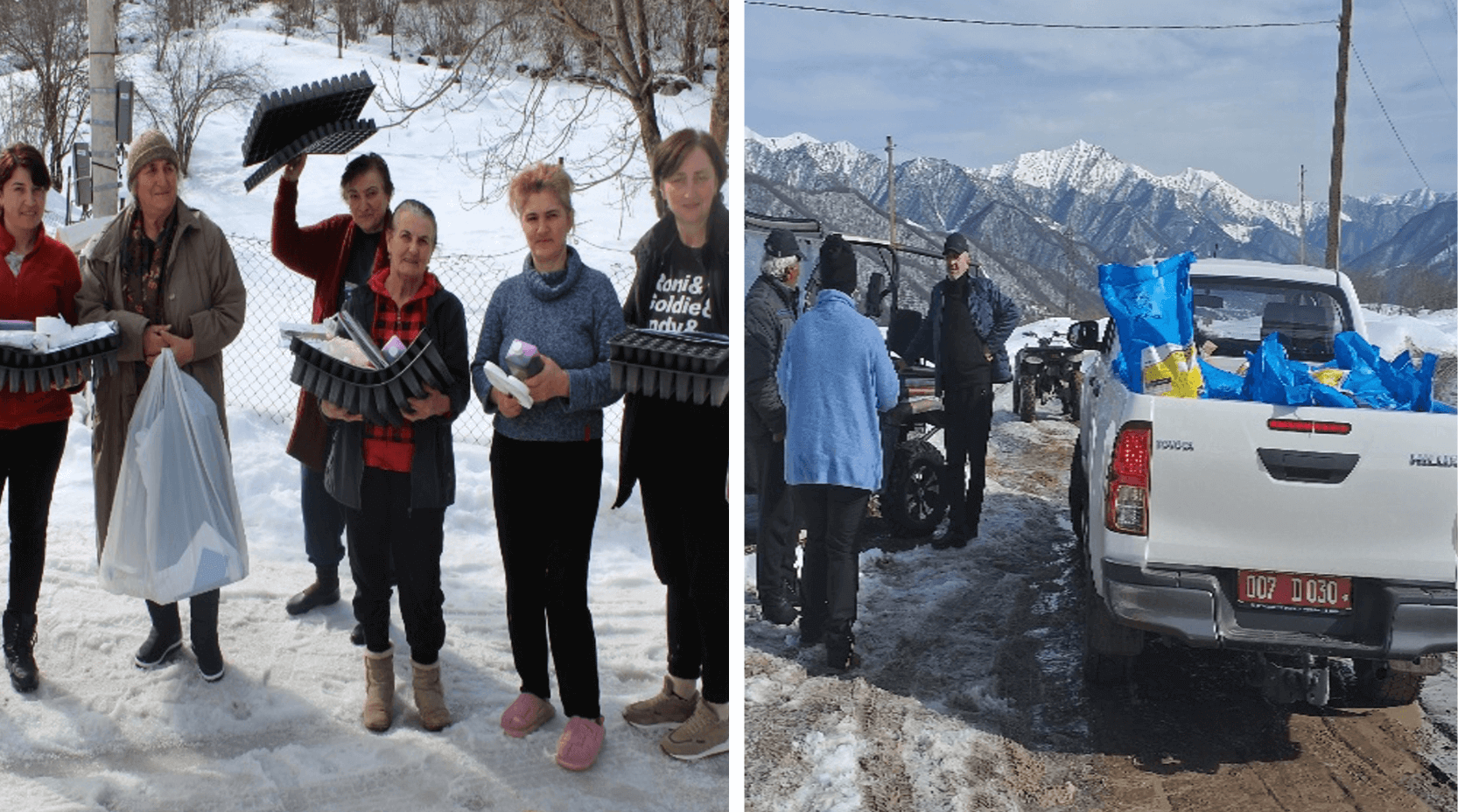
On February 14, a new training group was created for the residents of Bedoni, to whom FAO agronomy trainer, Mikheil Taktakishvili, conducted training in agronomy, the topic – gardening and growing seedlings correctly. Cassettes for growing seedlings and fertilizers were distributed to the participants. 7 people (6 women and 1 man) attended the training.

The effectiveness of the trainings caused interest among the local population, therefore, new sessions in the direction of cheese production are planned from spring.